• Skip to primary navigation
  • Skip to main content
  • Skip to primary sidebar
  • Skip to footer

Johns Hopkins Medicine Lyme Disease Research Center

Show Search
Hide Search
  • Lyme Disease
    • Signs & Symptoms of Lyme Disease
    • Diagnosis of Lyme Disease
    • Lyme Disease Treatment and Prognosis
    • Lyme Disease Prevention and Tick Removal
    • Frequently Asked Questions (FAQs)
    • Lyme Disease Video Introduction Series
    • Lyme Disease Video Education Resources
  • About the Center
    • Meet Our Team
    • Make an Appointment
    • Address & Directions
    • Refill a Prescription
    • Lyme and Tickborne Disease Fellowship Program
    • Subscribe to Our Email Newsletter
  • News & Impact
    • Impact Report
    • Newsletters
    • Research News
    • In The News
    • Talks by John Aucott, MD
    • Subscribe to Our Email Newsletter
  • Research Studies
    • Open Research Studies
    • Clinical Trials Network for Lyme and Other Tick-Borne Diseases
    • Research Publications
    • Lyme Disease Epidemiology
  • Make a Gift
  • Newsletter Signup
Home / Lyme Disease / Lyme Disease Prevention and Tick Removal

Lyme Disease Prevention and Tick Removal

Prevention

New cases of Lyme disease have increased to close to 500,000 annually in the US. Knowing how to reduce your risk through preventative measures can protect you and your loved ones from this potentially debilitating infection.

The deer ticks that transmit Lyme disease are very small, about the size of a pinhead, and difficult to see. Taking proactive preventative steps is essential to minimize your risk.

Watch these prevention tips:

Protect Yourself Outdoors

  • Wear protective clothing: Treat clothing with permethrin, a tick pesticide
  • Use EPA-registered repellents: Apply tick repellent containing DEET or picaridin to exposed skin. Use this EPA tool to find the repellent that is right for you
  • Stay on trails: Avoid tall grass, brush, and leaf litter where ticks are commonly found
  • Create a tick-safe zone: Maintain your yard to reduce tick habitats around your home

After Outdoor Activity

  • Perform daily tick checks: Carefully inspect your entire body, especially in warm, moist areas (underarms, groin, scalp, behind ears, behind knees)
  • Shower promptly: Showering within 2 hours of coming indoors can help wash off unattached ticks
  • Dry clothes on high heat: Place clothing in the dryer on high heat for at least 15 minutes to kill any ticks
  • Check pets: Ticks can hitch a ride on pets and then transfer to humans

Risk is Year-Round

Although Lyme disease risk is greatest during warmer months (May through July), tick activity and infection risk can occur throughout the year in many regions.
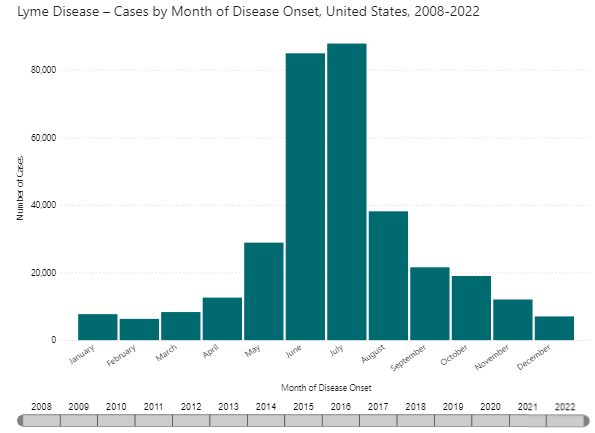
Source: cdc.gov/lyme/datasurveillance/surveillance-data

Removing Ticks

Act Quickly

Tick attachment time matters. Removing ticks as soon as possible reduces the risk of infection. You cannot get sick from a tick that is crawling on you but has not yet bitten. If the tick is attached, it will be difficult to pull off.

Proper Removal Technique

  • Use fine-tipped tweezers: Grasp the tick’s mouthparts as close to the skin surface as possible
  • Pull steadily upward: Use steady, even pressure without twisting or jerking
  • Be patient: The tick’s mouthpart has barbs, so removal takes time and care
  • Pull straight out: Do not pull back sharply, as this may tear the mouthparts and leave them embedded in the skin

What NOT to Do

  • Do not squeeze or crush the tick’s body; this may force infected fluids into the skin
  • Do not twist or jerk the tick; this can break off the mouthparts
  • Do not apply petroleum jelly, nail polish, rubbing alcohol, or a hot match to the tick while attached; these methods can cause the tick to regurgitate infected fluids into the wound

After Removal

  • Clean the area: Wash the bite site and your hands thoroughly with soap and water, then apply rubbing alcohol or antiseptic
  • Dispose of the tick: Submerge in alcohol, place in a sealed bag, or flush down the toilet
  • Monitor the bite site: Watch for signs of an expanding red rash over the next two weeks
  • Watch for symptoms: Be alert for flu-like symptoms including fever, fatigue, headache, or body aches
  • Check for more ticks: If you found one tick, there may be others on you or family members
  • Consider tick testing: Consult with your healthcare provider about sending the tick to a lab such as TickCheck or TickEncounter to be tested for pathogens
  • If mouthparts remain embedded: Don’t panic! Embedded mouthparts alone do not transmit Lyme disease. Clean the area and allow the skin to heal naturally, or consult your healthcare provider
  • Seek medical attention: If a rash appears, take a dated photo, track your symptoms, and contact your doctor immediately


Receive the Latest News from the Johns Hopkins Lyme Disease Research Center

Receive the Latest News from the Johns Hopkins Lyme Disease Research Center

Join our mailing list to receive the latest news and updates from Johns Hopkins Rheumatology and the Johns Hopkins Lyme Disease Research Center.

Interested In

You have Successfully Subscribed!

Use of This Site

All information contained within the Johns Hopkins Lyme Disease Research Center website is intended for educational purposes only. Physicians and other health care professionals are encouraged to consult other sources and confirm the information contained within this site. Consumers should never disregard medical advice or delay in seeking it because of something they may have read on this website.

Primary Sidebar

Learn about Lyme Disease

  • Lyme Disease Overview
  • Signs & Symptoms of Lyme Disease
  • Diagnosis of Lyme Disease
  • Lyme Disease Treatment and Prognosis
  • Lyme Disease Prevention and Tick Removal
  • Frequently Asked Questions (FAQs)

Lyme Disease Tips

  • Preventing Tick Bites and Lyme Disease
  • What to Do After a Tick Bite

Dr John Aucott sitting in a chair in front of a brick wall discussing Lyme Disease

Lyme disease is a multi-system bacterial infection which is transmitted to humans through the bite of an infected deer tick.

In this Lyme Disease Video Series, Dr. Aucott walks through Lyme Disease including disease overview, signs and symptoms, diagnosis, treatment and prognosis.

OPEN STUDIES

LEARN MORE ABOUT OPPORTUNITIES TO PARTICIPATE IN OUR RESEARCH STUDIES

LEARN MORE ABOUT A PILOT STUDY to investigate tetracycline treatment tolerability in people with post-treatment Lyme disease

LEARN MORE ABOUT PSILOCYBIN PILOT STUDY FOR POST TREATMENT LYME DISEASE

Footer

Johns Hopkins Rheumatology

  • Johns Hopkins Rheumatology
  • Arthritis Center
  • Lupus Center
  • Myositis Center
  • Scleroderma Center
  • Sjögren’s Syndrome Center
  • Vasculitis Center

Connect with Us

  • Facebook
  • Twitter
  • YouTube

U.S. News and World Report Rankings Badge

Johns Hopkins Medicine Johns Hopkins Medicine logo
Language Assistance Available:
  • Español
  • American Sign Language
  • עִברִי
  • אידיש
  • አማርኛ
  • 繁體中文
  • Français
  • Tagalog
  • Русский
  • Português
  • Italiano
  • Tiếng Việt
  • Ɓàsɔ́ɔ̀-wùɖù-po-nyɔ̀
  • Igbo asusu
  • èdè Yorùbá
  • বাংলা
  • 日本語
  • 한국어
  • Kreyòl Ayisyen
  • العربية
  • Deutsch
  • Polski
  • Ελληνικά
  • ગુજરાતી
  • ภาษาไทย
  • اُردُو
  • فارسی
  • हिंदी
  • Deitsch
  • ខ្មែរ
  • မြန်မာ
Contact & Privacy Information
Price Transparency
Notice of Privacy Practices Privacy Statement
Terms & Conditions of Use Non-Discrimination Notice
Manage Cookie Preferences
Copyright © 2025 Johns Hopkins Rheumatology